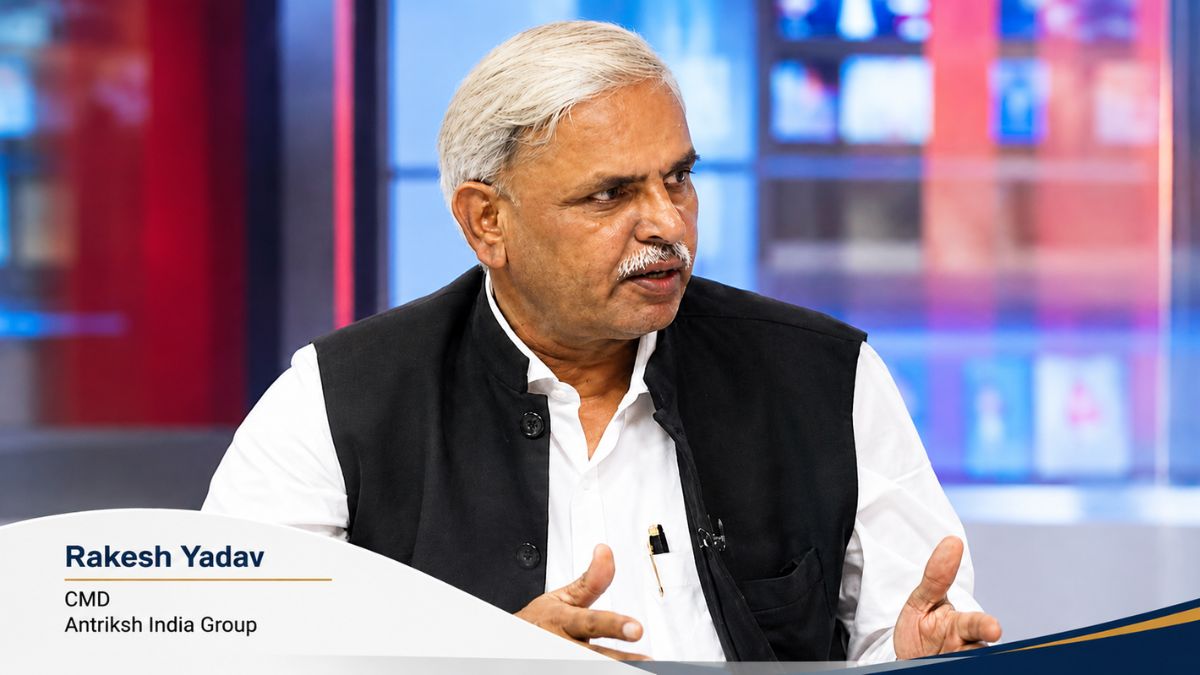
By Rakesh Yadav
CMD, Antriksh India Group
China’s real estate market, long a global engine for growth, has taken a dramatic turn. Property prices in some parts of the country have plunged back to levels not seen since 2005. This correction, driven by oversupply, a bursting bubble of investment-fueled growth, and tightening regulations, has sent shockwaves through global markets, leaving investors worldwide grappling with uncertainty. Naturally, in India, a common question echoes from homebuyers and investors alike: Could India be next? Will our real estate market follow in China’s footsteps?
As an industry expert and developer, deeply attuned to the Indian realty landscape and its core drivers, my response is an unequivocal “No.”
While a healthy degree of caution is always prudent in any market, comparing the Indian and Chinese real estate scenarios is fundamentally flawed—a classic case of comparing apples to oranges. China’s predicament is the consequence of unique structural dynamics and cultural trends that simply do not apply to India. The narratives are completely different. China’s real estate story was, for a long time, built on a shaky foundation of speculative investment. India’s story, on the other hand, is built on the far more solid ground of necessity and sustainable growth.
The Indestructible Core: India’s Demand is Driven by Basic Need
The key differentiator is the underlying demand. India is currently witnessing one of the largest and most rapid waves of urbanization in history. Millions of families are aspiring for homeownership, driven by a simple, fundamental need: to have a home of their own.
Every year, millions of young Indians are entering the workforce, getting married, and starting families, creating a consistent and massive demand for new housing. This is not speculative buying driven by hopes of record-breaking investment gains, as was the case in China. It’s a demand rooted in aspiration, rising disposable incomes, and the universal human desire for stable shelter. In China, real estate became a preferred investment vehicle, leading to millions of units sitting empty and purely intended to generate wealth. In India, a home is a place to live, not an entry in a speculative portfolio.
The Crucial Shift: RERA, Transparency, and Actual End-Users
The Chinese model encouraged developers to take on massive debt (leverage) to build, build, and build some more, leading to a huge overhang of unsold inventory—ghost towns of empty high-rises. In contrast, India’s real estate market has, in recent years, undergone a profound transformation. The implementation of landmark reforms like the Real Estate (Regulation and Development) Act, 2016 (RERA), along with Demonetization and GST, has injected a unprecedented level of transparency and accountability into the system.
RERA, in particular, has been a game-changer. It has empowered buyers, standardized practices, and disciplined developers. The days of opaque dealings and unchecked developer leverage are largely a thing of the past. This has fostered a market where projects are more likely to be completed, and more importantly, where units are purchased by genuine end-users with a real intention to reside in them. This fundamental shift from speculative investment to demand-driven purchases is India’s greatest bulwark against a Chinese-style crash.
Expansion Beyond Metros: Tier-2 and Tier-3 Cities Take Center Stage
Another key factor is the geographic diversification of India’s growth. The real estate narrative is no longer confined solely to the gleaming skylines of Mumbai, Delhi, or Bengaluru. There is a powerful, parallel wave of development sweeping across India’s Tier-2 and Tier-3 cities.
This growth is being supercharged by massive infrastructure projects, from new highways and expressways to airport expansions and rapid transit systems. Better connectivity is unlocking the potential of these emerging urban centers. When a new highway connects a Tier-2 city to a major metropolis, it creates new suburban hubs and new satellite towns. This, in turn, fuels demand for housing and commercial spaces. As connectivity improves, so do land values and demand, creating a self-reinforcing cycle of sustainable growth. The demand, therefore, isn’t concentrated; it’s broad-based, resilient, and spread across the diverse fabric of the nation.
The Bottom Line: Real Estate is not Just an Investment in India; it’s an Emotional and Social Goal
In India, the concept of home is deeply ingrained in the culture. It’s not just a physical structure; it’s an emotional sanctuary and a significant social achievement. A home is a lifelong goal, a cornerstone of financial security, and a testament to hard work.
While investment-driven buyers may run for the hills during economic downturns, end-user demand is far more resilient. Families will continue to prioritize owning a home through various economic cycles, especially as their incomes rise and their aspirations for a better life grow. India’s “Roti, Kapda, aur Makan” (Food, Clothing, and Shelter) philosophy is a deeply relevant one. Homeownership is a non-negotiable part of that trinity.
So, while China’s real estate sector may be experiencing a complex correction, the pillars supporting India’s market are vastly different. Driven by fundamental need, reinforced by transparency and infrastructure growth, and anchored by a strong cultural desire for a home, India’s real estate market is on a sound, demand-driven path. A crash, in the style of China, is not just unlikely—it’s simply not part of India’s property market narrative.